







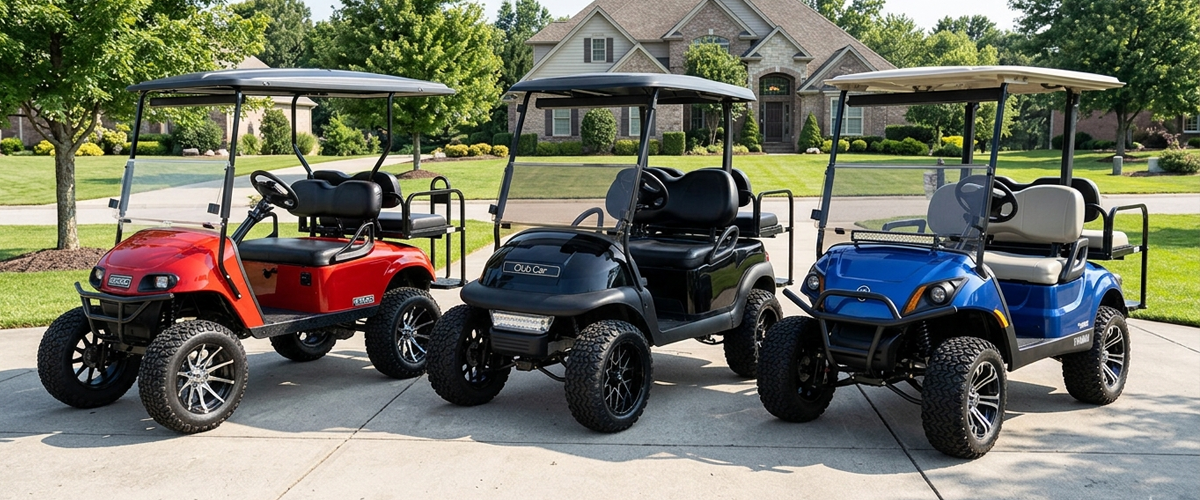
Here's the thing about lift kits: they're one of the most impactful upgrades you can make to a golf cart, and also one of the easiest ones to get wrong. The wrong lift for your cart or your use case means handling problems, compatibility headaches, and parts that don't fit without modification. We've seen it too many times. This guide cuts through the noise so you pick right the first time.
Why Lift? The Actual Reasons That Matter
There are two legitimate reasons to lift a golf cart. The first is clearance: if you're running terrain beyond a groomed fairway, stock ground clearance (typically 4–5 inches) isn't enough. Roots, rocks, ruts, and uneven campground terrain will find the undercarriage of a stock cart. A 3" or 5" lift changes that math dramatically.
The second reason is tire fitment. Larger tires need clearance to turn without rubbing. If you want to run 21"+ tires (which meaningfully change the look, the traction, and the trail capability of your cart) you need a lift to support them. One drives the other.
The visual stance upgrade is real too, but if that's the only goal, don't overlook wheel spacers as a simpler, lower-cost option. More on that below.
Four Types of Golf Cart Lift Kits: Before You Buy
Golf cart lift kits aren't one-size-fits-all. Not even close. There are four distinct lift types on the market, each built for a different platform, budget, and use case. Here's what each one is, what it does, and who it's for.
Block Lifts
Block lifts are the entry point of the lift kit world. They use a solid spacer block (typically steel) installed between the leaf spring and the axle to push the frame up relative to the wheels. No suspension components are replaced; you're literally stacking height. Installation is simple, cost is low, and they're a solid choice for owners who want 2–3" of clearance for light terrain without a major mechanical project.
The honest limitation: block lifts don't improve suspension travel or geometry. If you're running stock-size or slightly larger tires on groomed or gravel terrain, a block lift gets the job done. If you're running serious all-terrain tires on rough trail, you'll want more than a block.
Best for: Light clearance gains, budget-friendly builds, neighborhood and campground use.
Spindle Lifts
Spindle lifts use modified spindle assemblies to reposition the wheel hub lower relative to the frame, effectively raising the cart body without changing the spring or axle position. They deliver a cleaner geometry change than a block lift, handle tire sizes up to 22" well (except for Club Car Precedents, which need a 6" lift kit for tires 21" and above), and are still a manageable DIY install for someone comfortable with front-end work.
Club Car DS and Precedent owners in particular get a lot of mileage out of spindle lifts; the platform responds well to them. They're also a good fit for EZGO owners who want a step up from a block lift without committing to a full suspension rebuild.
Best for: Club Car DS and Precedent. 3" lift, tires up to 22–23", neighborhood to light trail use.
Drop Axle Lifts
Drop axle lifts are the EZGO-specific solution for owners who want more lift than a block provides without going all the way to a full A-arm kit. A drop axle replaces the front axle with a modified unit that positions the spindle lower, raising the front of the cart. The result is typically 4–6" of lift with better geometry than a stacked block and better tire clearance than a spindle kit alone.
If you're an EZGO TXT owner running 23–25" tires on mixed terrain, campground roads, dirt paths, or light trail, a drop axle kit is often the sweet spot. More capable than a block, less involved than a full A-arm swap, and priced between the two.
Best for: EZGO TXT. 4–6" lift, tires up to 23–25", mixed terrain and light trail use.
A-Arm and Double A-Arm Lifts
Standard A-arm lifts replace the front suspension components entirely with extended control arms, increasing wheel travel and maintaining more accurate suspension geometry through the full range of motion. If you're running 5"–6"+ of lift and 22"+ tires on actual trail terrain (not just gravel paths, but roots, rocks, and inclines), an A-arm lift is where the conversation starts.
Double A-arm lifts take that further. Instead of a single lower control arm, a double A-arm (also called a dual A-arm or four-link front suspension) uses both upper and lower control arms, giving you significantly more wheel travel, better camber control through suspension compression, and a more stable platform under aggressive off-road load. These are for serious builds: lifted Club Car Precedents running 25"+ tires on real terrain, or Yamaha Drive builds chasing maximum capability.
The trade-offs are install complexity and cost. A double A-arm lift is not a weekend driveway project for most owners. Plan for an alignment check after install, and if you haven't done front-end suspension work before, this one's worth having a shop handle.
Best for: Club Car DS and Precedent (A-arm and double A-arm) · Yamaha Drive/G29 (A-arm and double A-arm). 5–6"+ lift, 25"+ tires, trail riding, hunting, serious off-road builds.
Lift Kit Compatibility by Cart Brand: Get This Right First
This is where we see the most costly mistakes. Lift kits are not universal, and it's not just about model. It's about which lift type works with which platform. Club Car, EZGO, and Yamaha each have their own compatible options, and mixing them up means parts that either don't fit or don't perform the way you expect. Here's the breakdown:
| Cart Brand / Model | Compatible Lift Types | Lift Range | Notes |
|---|---|---|---|
| Club Car DS (1982–current) | Spindle · Double A-Arm | 4" – 6" | Most versatile Club Car platform; wide kit selection. Spindle for 4" street builds; double A-arm for better ride and off-road ability. Shop Club Car DS Lift Kit/Wheel Combos |
| Club Car Precedent (2004–current) | Double A-Arm | 6" | Precedent-specific kits only; do not cross-fit DS kits. A-arm front suspension stock; confirm kit matches year. Shop Club Car Precedent Lift Kit/Wheel Combos |
| EZGO TXT (1994–current) | Block · Drop Axle | 5" – 6" | Long production run; confirm year before ordering as geometry changed in 2014. Block for light gains; drop axle for 4–6" with better geometry. Shop EZGO TXT Lift Kit/Wheel Combos |
| EZGO RXV (2008–current) | A-Arm | 6" | Independent rear suspension; use RXV-specific kits only. A-Arms with coil-overs gives the best clearance-to-install ratio and ride performance on this platform. Shop EZGO RXV Lift Kit/Wheel Combos |
| Yamaha G2-G20/G29/Drive 2 | Block · A-Arm · Double A-Arm | 4" – 6" | Most flexible Yamaha platform for lift options. Confirm gas vs. electric, as frame differences affect fitment on some A-arm kits. Shop Yamaha Lift Kit/Wheel Combos |
We can't emphasize this enough: when in doubt, call us. That's what the product specialists at (704) 964-6839 are there for. They'll confirm compatibility before you order, not after you're staring at a pile of parts that don't match your cart.
Pairing Your Lift With the Right Tires
A lift kit without a tire upgrade is a missed opportunity. A tire upgrade without the right lift is a clearance problem. Here's how they stack up together:
| Lift Height | Max Recommended Tire Size | Typical Use Case |
|---|---|---|
| 4" | Up to 22" (20" for Club Car Precedent) | Campground, light trails, mixed terrain |
| 5" | Up to 23" (21" for Club Car Precedent) | Trail riding, hunting, rough terrain |
| 6"+ (A-arm) | Up to 24" with correct offset wheel (22" for Club Car Precedent) | Serious off-road, aggressive builds |
Installation: What to Expect
Install complexity scales with lift type. A block lift is the most accessible DIY job, requiring no specialized tools and typically under 2 hours. A spindle lift is a step up, but still manageable for someone comfortable with front-end work; plan for 2–4 hours. A drop axle kit involves axle removal and is a solid half-day job with the right tools. A double A-arm lift is the most involved, as you're replacing the entire front suspension, and an alignment check after install is non-negotiable. If you haven't done front-end suspension work before, the A-arm and double A-arm kits are reasonable ones to have a shop handle.
Regardless of which lift you install, plan to re-torque all hardware after the first 25–50 miles. Vibration settles bolts, and a quick re-torque is cheap insurance on a lift you just spent real money on.
Hardware Torque Reference After Install
- Block lift U-bolts (leaf spring): 40–50 ft-lbs
- Spindle mounting bolts: 35–45 ft-lbs
- Drop axle mounting hardware: 45–55 ft-lbs
- A-arm pivot bolts (single and double): 45–55 ft-lbs
- Shock absorber mount bolts (top and bottom): 30–40 ft-lbs
- Wheel lug nuts (stock pattern): 50–65 ft-lbs
- Lug nuts with wheel spacers: 75 ft-lbs
Already Lifted? Do a Spring Re-Torque
If your cart has been sitting since October, your lift hardware has been through thermal cycling all winter. Bolts lose clamping force over time; that's not a defect, it's physics. A spring re-torque takes twenty minutes and is the difference between a solid-feeling cart and one that develops a rattle by June. We covered this in detail in our Spring Golf Cart Prep Guide, so check the lift kit section.
The Bottom Line
A good lift kit transforms a golf cart from a fairway appliance into something you actually want to take off the pavement. Get the compatibility right, match your lift to your tire goals, and don't skip the re-torque after break-in. The builds that hold up aren't the ones with the most lift. They're the ones done correctly the first time.
Ready to Lift?
Browse our full lineup of golf cart lift kits, compatible with EZGO, Club Car, and Yamaha. Every kit is backed by the Hardcore Parts warranty and real product specialist support.
Bundle & Save on Lift Kit/Wheel Combos →
Questions about fitment? Call us at (704) 964-6839, 9am–5pm EST