








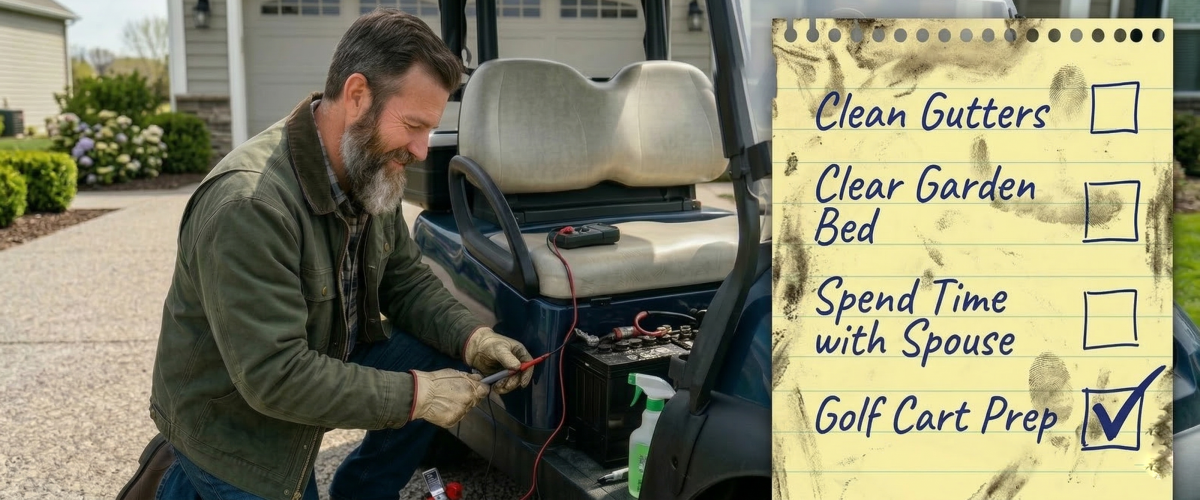
Your cart's been sitting in the garage since November. Maybe you threw a battery maintainer on it before the cold set in, maybe you didn't. Either way, first warm Saturday of spring shouldn't end with you pushing a dead cart back up the driveway.
To help answer the question “What attention does my golf cart need in the spring?”, we consulted with an experienced golf cart technician who services carts coming out of winter storage every year. The below checklist is the answer, and the good news is it isn't a complicated process. Honest technicians are happy to admit you don't need a lift, a shop full of tools, or two hours blocked out. Most of this takes thirty minutes in your driveway (but some carts may need more love than others).
Who This Guide Is For
Any golf cart owner coming out of winter storage - EZGO, Club Car, Yamaha, and although we have less experience with Chinese golf carts, those too. Whether you ride on the course, in your neighborhood, or on trails, this checklist applies to you.
If your cart sat for more than 30 days without a charge or a check, start here before you ride.
1. The Battery: Start Here First, Not Last
If you have lead acid batteries, cold weather plus sitting idle is a recipe for battery sulfation — a condition where lead sulfate crystals build up on the plates and permanently reduce capacity. You may not notice it until you're a mile from home and the cart starts dragging. Here's how to assess what you're working with.
Step 1: Check the Water Levels
Remove the vent caps on each cell and look at the water level. It should sit about 1/4" above the plates. Low water exposes the plates to air and accelerates sulfation. Top off with distilled water only — never tap water. Minerals in tap water contaminate the electrolyte and shorten battery life.
Step 2: Charge the Pack Fully
Before you test anything, run a full charge cycle. If you've been using the original OEM charger for more than three years, it may not be pushing a complete charge anymore — older chargers lose efficiency. A full charge is your baseline for everything that follows.
Step 3: Test Voltage After a Full Charge
With a fully charged pack, check voltage across each battery with a multimeter. On a 48V pack you're looking for 50–52V total; on a 36V pack, 38–40V. Individual batteries in a 48V 6-battery pack should read around 8.3–8.7V each. Anything significantly under that means a weak or dead cell.
If your charger is more than a few years old or isn't cutting charge times down to spec, a 48V Rapid Charger with auto shutoff is worth the upgrade. It cuts charge time, protects against overcharging, and extends overall battery life. Here are our favorite Rapid Chargers
2. Tires and Wheels: Pressure, Tread, and Lug Torque
For every 10°F drop in temperature, tire pressure drops roughly 1 PSI. If your cart sat from October through March, your tires are almost certainly underinflated — and underinflation doesn't just cause uneven wear. On a golf cart it affects steering geometry and puts extra stress on spindles and bearings.
Recommended Tire Pressure by Tire Size
| Tire Size | Recommended PSI |
|---|---|
| Stock cart tires (18–20") | 18–22 PSI |
| Lifted carts with 22–23" all-terrain tires | 15–18 PSI |
| Lifted carts with 25" or larger tires | 12–15 PSI |
While you're checking pressure, look at the tread. Carts that sat outside are prone to flat-spotting. Run your hand across the tread — if you feel a flat section or see sidewall cracking, that tire needs to be replaced before the season starts. Cracked sidewalls are a blowout risk, not just a cosmetic issue.
Check your lug nuts while the cart is on level ground. Stock wheel patterns torque to 50–65 ft-lbs. If you're running aftermarket wheels, check the manufacturer spec — it varies.
If you have wheel spacers installed, torque the spacer mounting bolts to 75 ft-lbs and the outboard wheel lug nuts to 75 ft-lbs as well.
3. Brakes: Don't Skip This One
Golf cart drum brakes are simple but they're not maintenance-free. Some surface rust on the drum face after winter storage is normal and will wear off in the first few stops. What you're looking for is cable stretch, drum wear, or pads that have worn past the friction material.
How to Check
- Push the cart manually on flat ground, then apply the foot brake — it should stop completely with a firm pedal. No sponginess, no pedal going to the floor.
- Set the parking brake and try to push the cart — it should not roll.
- Inspect the brake cable near the rear axle. Any fraying or visible corrosion means replace it before you ride.
- On heavy-use carts that are 3 or more years old, have a shop pull the drums and measure pad thickness if you haven't had it done recently.
If you're running larger tires on a lift, keep in mind that more rotational mass means your brakes are working harder on every stop. Lifted carts need more frequent brake inspections than stock setups.
4. Lift Kit Hardware: Re-Torque Before You Ride
Hardware works loose. Vibration from trail use, road surfaces, and temperature cycling all cause bolts to back off over time. A bolt properly torqued in October can lose 15–20% of its clamping force over a winter of thermal cycling. This isn't a defect — it's physics. The fix is a spring re-torque.
What to Check on a Spring Re-Torque
| Component | Torque Spec |
|---|---|
| Spindle mounting bolts (lift block to spindle) | 35–45 ft-lbs |
| A-arm pivot bolts (A-arm style lifts) | 45–55 ft-lbs |
| Leaf spring U-bolts (block lifts) | 40–50 ft-lbs |
| Shock absorber mount bolts (top and bottom) | 30–40 ft-lbs |
| Camber adjustment bolts (where applicable) | Torque to spec; check for visible camber change |
If you've never done a re-torque after the first season, now is the time. Twenty minutes with a torque wrench covers the whole front end.
5. Lights and Electrical: A Quick Walk-Around
Bulbs fail from temperature cycling. Wiring connections corrode, especially near the battery compartment where off-gassing from charging accelerates oxidation. This takes five minutes and it's worth doing before you're riding at dusk and realize your brake lights aren't working.
Quick Electrical Walk-Around
- Turn on headlights — both should illuminate at equal brightness. Significant difference in brightness usually means one bulb is failing.
- Apply the brake pedal — brake lights should activate immediately with no flicker.
- Check wiring harness connectors near the battery compartment for corrosion. White or greenish buildup on terminals means clean or replace.
- If you have a light bar or underbody lights, test the switch and check mounting hardware for loosening from vibration.
Your Complete Spring Prep Checklist
Here's everything from above in one place. Print it out, take it to the garage, and check it off before your first ride. If you are short on time, items with an asterisk* are necessities for a quick spring checkup.
- Battery water levels*Distilled water, 1/4" above plates on each cell
- Full charge cycle completed*48V: 50–52V post-charge • 36V: 38–40V post-charge
- Individual battery voltageAll cells within 0.5V of each other
- Tire pressure*Inflated to spec for your tire size — check sidewall max PSI
- Tire tread and sidewalls*No flat spots, no cracking, no bead damage
- Lug nut torque50–65 ft-lbs stock • 75 ft-lbs with spacers
- Wheel spacer bolts75 ft-lbs, hub-centric seated properly
- Foot brake feel and stopping*Firm pedal, full stop, no sponginess or floor travel
- Parking brake hold*No roll with brake set on flat ground
- Brake cable conditionNo fraying, no corrosion at rear axle
- Lift kit hardware re-torquePer spec for your lift type — see table above
- Lift block integrityNo cracking, no deformation
- Headlights and taillights*Both working, equal brightness
- Brake lights*Immediate activation on pedal press, no flicker
- Wiring connector conditionNo corrosion, clean connections near battery compartment
Get Out There — But Get It Done First
We all know that like taking care of our bodies, most things in life are just about paying attention. Golf cart maintenance, or any automotive maintenance for that matter, is no different. A dead battery, a loose bolt, or a dragging brake will sideline you faster than the thirty minutes it takes to go through this list. Do it once at the start of the season and you won't be thinking about it again until fall.
Have a question about fitment on your specific cart model, or need help diagnosing a battery issue? Call our team at (704) 964-6839 — our specialists have been doing this for 15 years.